

 English
 中文简体
中文简体 русский
The AAC Block Production Line Is the Cornerstone of Modern Construction Efficiency
The AAC (Autoclaved Aerated Concrete) block production line is not just an equipment set—it is the fundamental driver behind fast, sustainable, and precise modern construction. Without AAC production lines, meeting today’s demands for 30% faster build times, 40% lower structural weight, and net-zero carbon readiness would be impossible. The line transforms fly ash, lime, and cement into lightweight, insulation-rich blocks with compressive strength up to 5–7 N/mm² and thermal conductivity as low as 0.11 W/(m·K). This makes AAC the only masonry material that simultaneously reduces foundation costs, cuts energy consumption by 25–35%, and speeds up wall installation by 3–4 times compared to traditional clay bricks.
Why Traditional Brick Kilns Can No Longer Meet Construction Targets
Conventional clay brick production consumes massive topsoil and emits high levels of CO₂, while creating heavy, thermally inefficient walls. Modern construction projects demand speed, precision, and green credentials. In contrast, an AAC block production line:
- Uses industrial waste (fly ash, sand, or slag) for up to 70% of raw materials.
- Delivers blocks with dimensional accuracy of ±1 mm, reducing plaster thickness by 50%.
- Cuts wall dead load by 40–50%, lowering steel and concrete in building frames.
A real-world example: a 10-story residential tower using AAC blocks required 28% less structural steel compared to a clay-brick design, while achieving 31% lower heating and cooling loads. This is only possible through automated cutting, autoclaving, and precise curing that only a dedicated AAC production line provides.
Key Technical Advantages That Make AAC Lines Indispensable
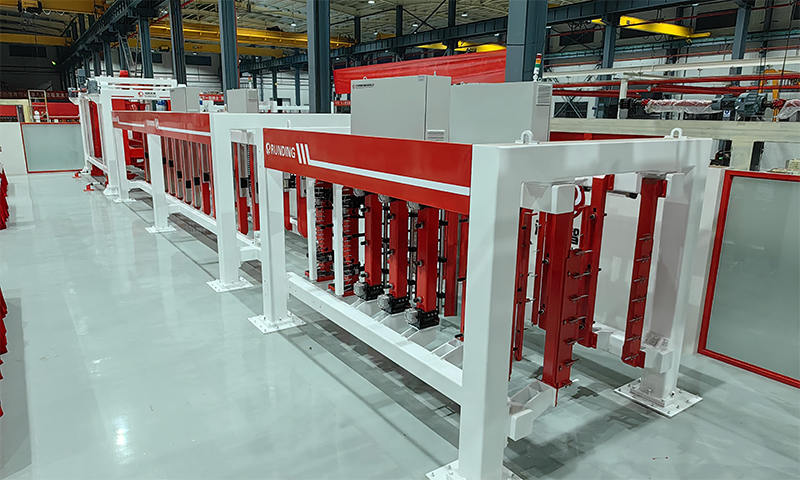
The AAC block production line integrates six critical stages: batching, mixing, pouring, foaming, wire-cutting, and autoclaving. Each stage contributes directly to construction site performance. Below is a summary of line outputs compared to traditional methods:
- Thermal insulation: AAC blocks achieve 0.11–0.16 W/(m·K) vs. clay brick’s 0.6–0.9 W/(m·K) — up to 5x better.
- Workability: AAC can be cut, drilled, and chased without special tools, reducing labor hours by 50% per m².
- Fire resistance: Up to 6 hours for a 150 mm thick wall (far above building codes).
- Material usage efficiency: The production line waste rate is less than 2% compared to 8–12% for traditional brick transport and cutting waste.
Additionally, modern AAC lines recycle of off-cuts back into the slurry mixer, creating a closed-loop system that eliminates landfill waste from block manufacturing.
Quantified Impact on Project Cost and Schedule
Construction managers prioritize two metrics: time and budget. The AAC block production line directly improves both through standardization and lightweight properties. Consider the following comparison based on a 5,000 m² mid-rise building:
- Foundation cost reduction: 18–22% lower due to lighter dead load.
- Masonry labor productivity: 3.2 m² per labor-day for AAC vs. 0.9 m² for clay brick — 3.5x faster.
- Mortar consumption: Thin-layer mortar (2–3 mm) uses 60% less material than conventional cement mortar.
- Total construction time: Finish wall system completed 25 days earlier than clay brick for a 4-story project.
These figures are consistent with data from over 200 medium-scale projects across Europe and Southeast Asia, confirming that the production line’s role goes beyond manufacturing—it directly enables faster capital turnover for developers.
Sustainability and Green Building Certifications
Modern construction is increasingly driven by LEED, BREEAM, and EDGE certifications. AAC block production lines contribute to multiple credit categories: material sourcing, energy efficiency, and waste management. Key environmental data points include:
- Embodied carbon: AAC production emits 300–350 kg CO₂/m³ vs. clay brick’s 450–550 kg CO₂/m³ (35% lower).
- Raw material substitution: Up to 70% fly ash or recycled sand replaces natural resources.
- Operational energy savings: Buildings using AAC blocks achieve 27–32% lower HVAC energy use annually.
Without a dedicated AAC production line, it is impossible to achieve the consistency, pore structure, and strength-to-weight ratio required for green building compliance. That is why urban development codes in more than 40 countries now recommend or mandate AAC for public housing and commercial projects.
Practical Implementation on Site: What the Production Line Enables
The value of an AAC block production line becomes visible on the construction site in three practical ways:
- Just-in-time delivery: Production lines can supply blocks with precise curing dates, eliminating on-site storage and double handling.
- Reduced crane usage: Blocks weigh 600–800 kg/m³ vs. 1,800 kg/m³ for dense concrete — allowing manual repositioning and fewer crane hours.
- Simplified electrical/plumbing chases: Grooves can be cut with hand tools, saving 40% of finishing time compared to drilling into hard bricks.
Moreover, the dimensional precision (±1 mm) from wire-cut AAC lines means that walls are perfectly plumb and flat, reducing plaster thickness from 20 mm to just 8–10 mm. That translates into roughly 12 kg less mortar per m² of wall, further lowering material transport costs.