

 English
 中文简体
中文简体 русский
Introduction: The Final Frontier of AAC Automation
In the broader context of an AAC block production line, substantial attention has historically been devoted to the front-end processes: slurry preparation, pouring, and cutting. However, as manufacturers strive for a truly optimized AAC block manufacturing plant, the unloading and packing section has emerged as a critical bottleneck and, consequently, a significant opportunity for improvement. The journey of an autoclaved aerated concrete cake from the AAC block autoclave to a stack of saleable, transport-ready products involves a series of complex, labor-intensive tasks.
From Autoclave to Pallet: The Unloading Process
The transition from the AAC block autoclave to the packing section is the first step in the end-of-line process. This stage is historically fraught with challenges, including product damage and safety risks associated with manual or semi-automated handling. In a modern setup, the process begins as soon as the autoclave cycle completes.
The Mechanics of Automated Unloading
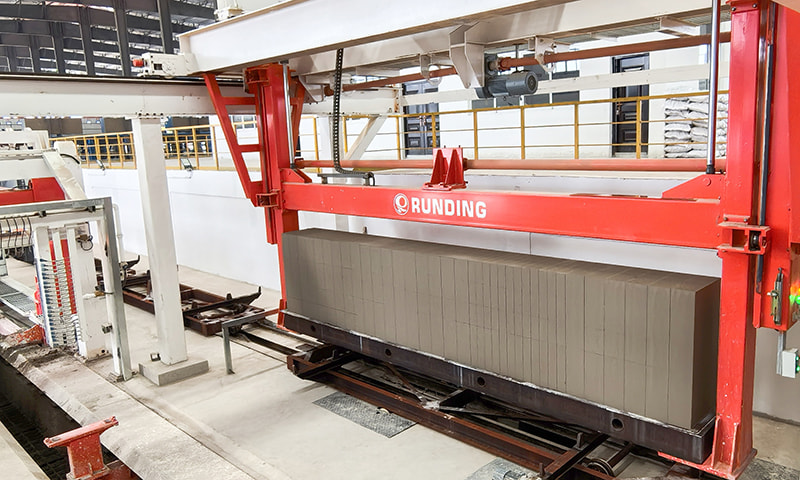
An automated unloading system typically involves a combination of specialized manipulators and conveyors. The autoclaved cake, still in its raw block form, is transferred from the autoclave trolley to the unloading station. For instance, in brownfield upgrade projects, such as the one implemented at a facility in Latvia, the solution involved a tilting table receiving the cake from an existing crane, subsequently tilting it 90 degrees for processing. This systematic approach, averaging a 5-minute cycle per cake, replaces manual forklift operations, enhancing both safety and throughput.
The system then undertakes the critical tasks of separation and sorting. After autoclaving, blocks within the "cake" may stick together. An automatic separation unit addresses this, layer by layer, preparing the blocks for the next phase. Some advanced systems incorporate sorting stations where a manipulator can remove full layers of blocks and replace them if damaged, ensuring that only high-quality products proceed to packing.
Packing Systems: Protecting Product Integrity
Once the blocks are separated and sorted, the packing phase begins. This is where the automatic AAC block production line demonstrates its full value by transforming loose blocks into secure, shippable units. The packing system is not merely about wrapping; it is about ensuring that the blocks arrive at the construction site in pristine condition.
Technology Components in Packing
- Layer stacking and grouping: A robotic or gantry-based system arranges blocks into precise layers, often with interleaving sheets to prevent abrasion.
- Stretch wrapping or strapping: After stacking, the unit is tightly wrapped with stretch film or secured with steel/plastic straps to maintain stability during transport.
- Palletizing and labeling: The final package is placed on a pallet, and automated labeling systems apply barcodes or RFID tags for inventory tracking.
In a fully automatic AAC block production line, the packing station is synchronized with the upstream cutting and curing processes, eliminating intermediate storage and reducing the risk of block damage from repeated handling. The table below compares key performance indicators (KPIs) for manual vs. automatic packing.
Note: Data derived from operational audits across multiple AAC block manufacturing plant facilities (2023–2025).
Economic Justification: ROI of Automatic Unloading & Packing
Investing in end-of-line automation is a strategic decision with measurable financial returns. For a mid-sized AAC block plant, the initial capital outlay for a fully automated unloading and packing system is typically offset within 24 to 30 months, driven by labor savings, reduced material waste, and enhanced throughput.
Breakdown of Cost Savings
- Direct labor reduction: A semi automatic AAC block production line still requires 3–4 operators for the packing area; a fully automated solution reduces this to a single supervisor, cutting annual labor costs by over 60%.
- Minimized product waste: Automated handling reduces chipping and breakage. For a plant producing 150,000 m³ annually, a 2.5% reduction in waste translates to an additional 3,750 m³ of saleable product per year.
- Energy efficiency: Modern electric manipulators and servo-driven conveyors consume up to 20% less energy than conventional pneumatic systems, contributing to lower operational expenses.
Furthermore, the consistent, high-quality packaging enhances brand reputation and customer satisfaction, reducing the frequency of returns and complaints. A case study of a Southeast Asian plant upgrading to a fully automatic AAC block production line reported a 35% increase in shipping capacity without expanding the factory footprint, simply by eliminating the bottleneck at the packing station.
System Integration: The Smart Factory Approach
Automatic unloading and packing systems are no longer standalone units; they are integral nodes within an AAC block production equipment network. Through Industrial Internet of Things (IIoT) connectivity, these systems communicate with the central control system, the AAC block casting machine, the AAC block cutting machine, and the autoclave controls.
Data-Driven Optimization
By capturing data on cycle times, block dimensions, and packing density, the production management software can fine-tune parameters to maximize output. For instance, if the cutting machine produces a slightly different block height, the packing robot automatically adjusts its gripping force and stacking pattern to compensate. This level of synergy is only possible when the entire line is designed as a cohesive system—a hallmark of a truly modern AAC block production line.
Future Outlook: What Lies Ahead for End-of-Line AAC Automation
The evolution of AAC block making machine technology is moving toward greater intelligence and flexibility. Several emerging trends are poised to redefine the unloading and packing segment:
- AI-driven quality inspection: Computer vision systems will inspect every block for surface defects, automatically diverting substandard units to a recycling conveyor.
- Adaptive packing algorithms: Machine learning models will optimize package configurations in real time based on order sizes and transport vehicle dimensions, minimizing empty space and reducing shipping costs.
- Collaborative robots (cobots): Next-generation AAC block production equipment will incorporate cobots that can safely work alongside human workers, facilitating easier upgrades and maintenance.
In addition, the push for sustainable construction will drive the adoption of eco-friendly packing materials, such as biodegradable films and recycled paper interleaves, which automated systems can handle with minimal adjustments.
Frequently Asked Questions
Q1: What is the typical payback period for an automatic unloading and packing system in an AAC block plant?
The payback period generally ranges from 24 to 36 months, depending on plant capacity and labor costs. For high-throughput facilities, the return on investment can be even shorter, often under 24 months, due to significant labor savings and reduced product damage.
Q2: Can an existing semi-automatic AAC block production line be retrofitted with automatic unloading and packing modules?
Yes, many suppliers offer modular upgrade packages that can be integrated into existing lines. However, the degree of integration depends on the control system architecture. A thorough site audit is recommended to identify any necessary conveyor modifications or software updates.
Q3: How does automatic packing affect the quality of AAC blocks during transport?
Automatic packing significantly enhances transport quality by ensuring consistent stacking, even tensioning of straps, and proper interleaving to prevent friction damage. Plants that have adopted automatic packing report a 60% to 70% reduction in transport-related claims.
Q4: What maintenance is required for the unloading and packing equipment?
Routine maintenance includes lubrication of robotic arms, inspection of suction cups and grippers, calibration of sensors, and periodic verification of strapping tension. Most manufacturers recommend a preventive maintenance schedule every 500–750 operating hours.
Conclusion: A Strategic Imperative for Modern AAC Plants
The role of automatic unloading and packing in a complete AAC block production line extends far beyond simple end-of-line handling. It is a critical enabler of operational efficiency, product quality, and cost competitiveness. As the construction industry continues to demand higher volumes and better quality, AAC block plant operators must view automation not as an expense but as a strategic investment that secures their position in a rapidly evolving market. From the AAC block cutting machine to the final packaged pallet, each component of the AAC block production equipment chain must work in concert—and the unloading and packing system is the vital link that delivers value to the customer's doorstep.