

 English
 中文简体
中文简体 русский
The demand for lightweight, sustainable, and high-performance building materials continues to rise. Among these, autoclaved aerated concrete (AAC) blocks have secured a strong position globally. However, operating an AAC block production line at peak efficiency remains a challenge for many producers. Inefficiencies result in material waste, higher energy consumption, uneven product quality, and increased labor costs.
Understanding the Core Stages of an AAC Block Production Line
Before improving efficiency, one must understand the key stages where losses commonly occur. A typical AAC block production line includes:
| Stage | Main Activity | Common Efficiency Leak |
|---|---|---|
| Raw material preparation | Silica sand, lime, cement, gypsum, aluminum paste batching | Inaccurate weighing, moisture variation |
| Mixing and pouring | Slurry mixing and mold filling | Inconsistent viscosity, delayed pouring |
| Rising and pre-curing | Aeration and initial setting | Temperature or humidity imbalance |
| Cutting | Wire cutting into precise block sizes | Wire breakage, misalignment |
| Autoclaving | High-pressure steam curing | Steam leaks, pressure fluctuations |
| Packaging and dispatch | Stacking, wrapping, loading | Manual bottlenecks, packaging damage |
Each stage directly affects the next. Improving the AAC block production line requires a system-wide perspective, not isolated fixes.
Raw Material Consistency: The Hidden Driver of Efficiency
Inconsistent raw materials are the number one cause of unstable production cycles. Variations in lime reactivity, sand fineness, or cement strength can alter slurry fluidity, rising time, and green strength before autoclaving. These variations force operators to adjust parameters constantly, disrupting rhythm.
How to improve:
- Standardize incoming material testing. Every batch of lime or cement should be tested for key parameters before entering silos.
- Use volumetric or gravimetric dosing systems with automatic feedback correction.
- Maintain moisture control for sand. Wet sand changes batch weights and water demand.
A well-fed AAC block production line runs smoother and stops less often. Consistency in input directly translates to consistency in output.
Mixing and Pouring Precision
The mixing stage determines two critical factors:
Homogeneity of the slurry
The rising behavior after pouring
Inefficient mixing causes uneven dispersion of the aluminum paste, resulting in inconsistent pore structure and variations in strength.
Actionable measures:
- Install timed mixing cycles with temperature-compensated water addition.
- Monitor slurry flowability using simple on-site slump tests or automated viscometers.
- Avoid delays between mixing and pouring. Even 2–3 minutes can change the rising profile.
A streamlined pouring sequence reduces mold waiting time and increases the number of pours per shift. This is a direct lever for raising throughput without adding equipment.
Cutting Accuracy and Wire Management
Cutting is where precision translates into final block geometry. Poor cutting efficiency results in:
- Scrap blocks due to dimensional errors
- Wire breakage causing downtime
- Rough surfaces that affect construction usability
Efficiency improvements:
- Use wire tension monitoring systems (without naming specific brands, look for systems with constant tension feedback).
- Schedule wire replacement based on meters cut or number of cakes, not on visual inspection alone.
- Align cutting frames periodically using laser alignment tools.
When the cutting stage runs smoothly, downstream autoclaving works at full capacity. A jam or delay here creates a bottleneck that propagates backward through the AAC block production line.
Autoclaving Cycle Optimization
Autoclaving consumes the energy and time in an AAC block production line. A typical cycle includes:
| Phase | Duration (approx.) | Efficiency Focus |
|---|---|---|
| Evacuation | 0.5–1 hr | Pump energy, seal integrity |
| Pressure rise | 1–2 hr | Steam generation rate |
| Holding | 4–7 hr | Constant pressure, minimal fluctuation |
| Exhaust | 1–2 hr | Heat recovery potential |
Key strategies:
- Heat recovery: Reuse exhaust steam to preheat water or raw materials. This reduces boiler load.
- Batch scheduling: Group similar block densities and thicknesses together to avoid pressure profile changes.
- Door sealing inspection: Small steam leaks add significant energy loss over months.
Efficiency here means balancing cycle time with compressive strength development. Rushing the holding phase reduces block quality; extending it wastes energy.
Material Flow and Handling Between Stages
Many AAC block production lines lose efficiency not in processing, but in transportation between stations. Cakes waiting on transfer cars, molds not returning quickly, or crane delays all reduce overall equipment effectiveness (OEE).
Optimization checklist:
- Map the actual time each cake spends moving vs. being processed.
- Standardize transfer car speed and positioning accuracy.
- Implement visual management for mold return loops (e.g., colored zones or simple counters).
Even a 10% reduction in inter-stage waiting time increases daily output without new machinery.
Autoclaved Aerated Concrete Efficiency Through Preventive Maintenance
Unplanned downtime is the enemy of efficiency. In an AAC block production line, one failed component—a pump, a wire cutter, a hoist—can stop the entire line.
High-impact maintenance practices:
- Daily operator checklists (5–10 items per station).
- Weekly inspection of autoclave door seals and safety interlocks.
- Monthly alignment check for cutting tables and transfer cars.
Track “mean time between stops” (MTBS) for each major section. When MTBS drops, investigate immediately. Do not wait for full breakdowns.
Energy and Resource Efficiency Metrics
Reducing input per block is as important as increasing output. Efficiency is not just speed—it is output divided by (energy + material + labor). Focus on these ratios:
| Resource | Efficiency Indicator | Target Direction |
|---|---|---|
| Electricity | kWh per cubic meter | ↓ |
| Steam | kg steam per m³ | ↓ |
| Water | L per m³ | ↓ |
| Scrap rate | % of total output | ↓ |
| Labor | man-hours per m³ | ↓ |
Monitoring these weekly allows trend-based corrections before costs become visible in monthly financial reports.
Workforce Training and Standardized Work
Technology alone does not create efficiency. Operators who understand why parameters matter make better real-time decisions.
Effective training methods:
- Visual standard operating procedures (SOPs) with photos of correct and incorrect states.
- Cross-training operators across mixing, cutting, and autoclaving so they see the full flow.
- Short daily shift handover meetings (10 minutes) to share issues from the previous shift.
When operators on an AAC block production line feel ownership of their station, efficiency improves without capital investment.
Lightweight Block Manufacturing Process Control Using Simple Data
Avoiding complex data presentation does not mean avoiding data altogether. Collect a small set of process variables:
- Pour-to-cut time variation
- Autoclave pressure holding deviation
- Daily scrap weight by stage
Plot these on a paper chart or whiteboard. When variation increases, investigate root causes. This low-tech method often catches problems faster than advanced systems.
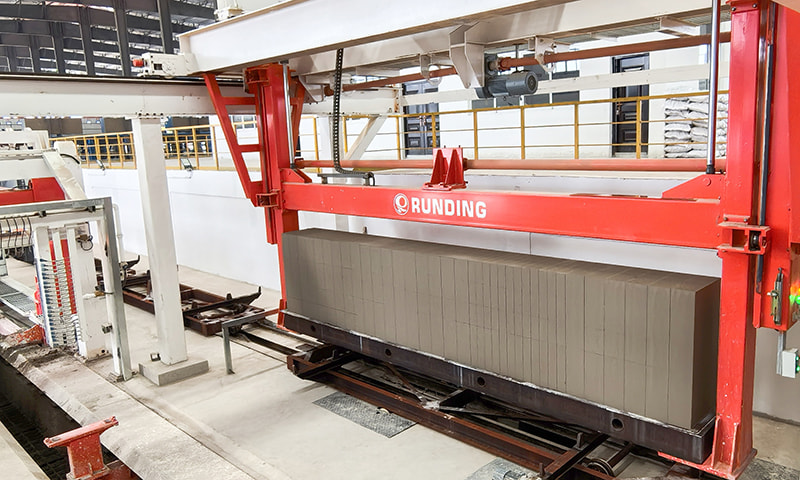
Production Line Optimization Through Layout Review
A poorly designed layout forces unnecessary material movement. Even in an existing plant, small layout changes can help:
- Relocate mold preparation closer to pouring.
- Position cutting waste conveyor directly back to slurry mixing (recycle lean slurry).
- Create a dedicated autoclave loading zone to avoid crane congestion.
Walk the production path from raw material entry to finished block dispatch. Every turn, lift, or wait adds non-value-adding time.
Avoiding Overproduction and Inventory Waste
Producing more blocks than the next stage can handle creates inventory piles. This hides problems like slow autoclaving or cutting delays. Apply a simple pull principle:
- Do not pour more molds than autoclaves can hold in the next 8 hours.
- Keep cutting synchronized with autoclave carts.
Inventory between stages should be minimal—enough to keep the next stage busy for 30–60 minutes, no more.
Summary of High-Impact Actions for an AAC Block Production Line
The following table summarizes the effective efficiency measures discussed, ranked by typical impact-to-effort ratio.
| Action Area | Specific Measure | Expected Benefit |
|---|---|---|
| Raw material | Daily moisture and reactivity check | Fewer pour adjustments |
| Mixing | Fixed sequence with temperature control | Uniform rising |
| Cutting | Scheduled wire changes | Less downtime |
| Autoclaving | Heat recovery + door seal inspection | Lower steam cost |
| Handling | Transfer car speed standardization | Faster cycle time |
| Maintenance | Daily operator checklist | Fewer unplanned stops |
| Training | Cross-training and visual SOPs | Better problem detection |
Conclusion
Improving efficiency in an AAC block production line is not about buying more machines or adopting unproven technology. It is about controlling variation, synchronizing material flow, and maintaining equipment discipline. Start with raw material consistency, then optimize mixing precision, cutting accuracy, and autoclaving energy use. Add preventive maintenance and workforce training as supporting pillars.
The result is a lightweight block manufacturing process that produces more cubic meters per shift, with lower scrap and energy costs. No single change delivers a miracle—but ten small improvements, steadily applied, transform the entire operation.