

 English
 中文简体
中文简体 русский
Introduction
Autoclaved aerated concrete (AAC) has become a cornerstone of modern construction due to its lightweight nature, thermal insulation properties, and fire resistance. However, the true value of AAC lies not only in these inherent characteristics but also in their consistency across production batches. Material performance stability—the ability to deliver uniform density, compressive strength, dimensional accuracy, and thermal conductivity from block to block—is what separates premium AAC from unreliable alternatives. Achieving this stability at scale is impossible without a well-engineered production system. This is where an AAC block production line plays a decisive role. By integrating automated control, process standardization, and real-time monitoring, an AAC block production line transforms a chemically sensitive raw material mix into a highly predictable end product.
Raw Material Precision: The Foundation of Stability
The stability of AAC begins with the accurate proportioning of its core ingredients: silica sand (or fly ash), lime, cement, gypsum, aluminum powder, and water. Even minor deviations in the ratio of these materials can erratic expansion, uneven pore structure, or compromised strength. A modern AAC block production line eliminates guesswork through automated weighing and dosing systems.
In a typical AAC block production line factory, each raw material is stored in dedicated silos or tanks, equipped with load cells or flow meters. When a batch is initiated, the control system automatically dispenses the exact quantity of each component according to a preset recipe. This level of precision is impossible in manual or semi-manual operations, where operator fatigue or judgment errors can introduce variability.
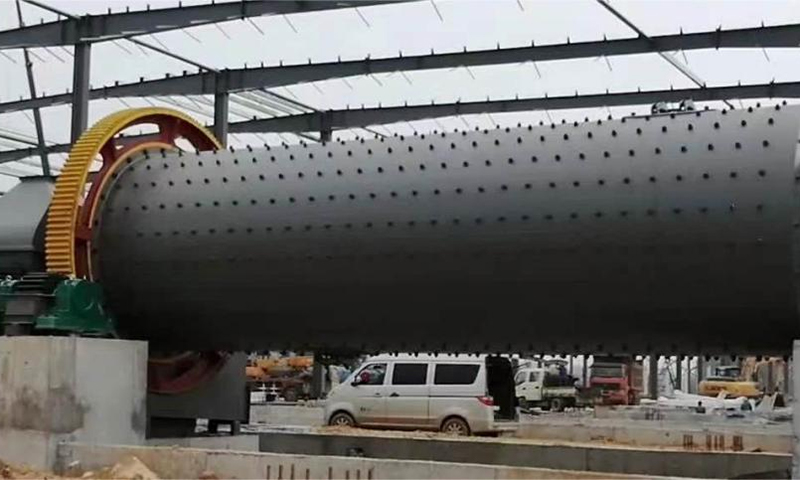
Furthermore, the production line often includes a preliminary material homogenization step. For example, sand is wet ground in a ball mill to achieve a consistent fineness, which directly influences the reactivity of the mix. The automated grinding circuit maintains a uniform particle size distribution, ensuring that the lime-silica reaction proceeds at a predictable rate during autoclaving. Without this control, coarse particles would weak spots, while overly fine particles might cause excessive early stiffening.
The table below summarizes how each raw material control point contributes to performance stability:
| Production Stage | Control Parameter | Impact on Material Stability |
|---|---|---|
| Sand grinding | Fineness (Blaine value) | Ensures uniform pozzolanic reaction |
| Cement/lime dosing | Weight accuracy (±1%) | Prevents strength fluctuations |
| Aluminum slurry preparation | Concentration & suspension | Regulates gas generation rate |
| Water addition | Temperature (40–45°C) | Controls initial hydration kinetics |
By maintaining these parameters within narrow bands, an AAC block production line ensures that every batch starts with an identical chemical and physical baseline. This repeatability is the pillar of material performance stability.
Mixing and Slurry Homogeneity
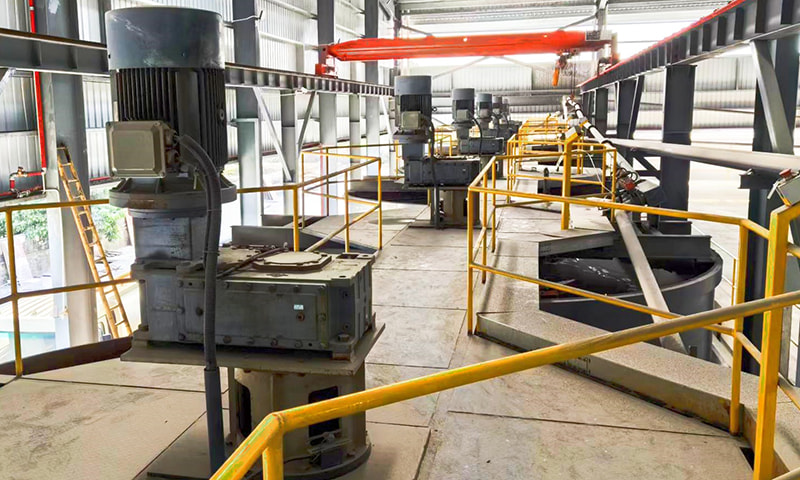
Once the dry components and water are combined, the mixture must be transformed into a homogeneous slurry with aluminum particles uniformly dispersed. Inadequate mixing leads to localized variations: some zones may have excess aluminum, causing large, interconnected voids; other zones may lack sufficient binder, resulting in low strength. An AAC block production line employs high-shear mixers or planetary mixers with precisely controlled cycle times and rotational speeds.
Modern lines also incorporate a premix stage where water and fines are combined before adding the aluminum paste. This prevents aluminum agglomeration, which is a common source of uneven pore distribution. The mixing cycle is monitored by sensors that track viscosity or power draw; when the target consistency is reached, the slurry is discharged automatically. This closed-loop control eliminates the variability introduced by operator decisions on mixing duration.
Moreover, the production line maintains a constant ambient temperature around the mixing station. Since the expansion reaction is exothermic and temperature-sensitive, even a 2–3°C deviation can alter the rise time. By integrating heating or cooling jackets on the mixer, an AAC block production line factory stabilizes the initial reaction environment, which results in consistent foaming behavior.
Controlled Expansion: The Critical Rise Phase
After mixing, the slurry is poured into molds where the aluminum reacts with lime and water to generate hydrogen gas. This gas creates millions of microscopic bubbles, giving AAC its cellular structure. The expansion phase is inherently dynamic: the slurry must maintain sufficient fluidity to allow bubble formation, yet develop enough green strength to prevent bubble coalescence or collapse. Achieving this balance batch after batch requires tight regulation of three variables: pouring temperature, waiting time, and environmental humidity.
An automated AAC block production line integrates these controls into a single programmable logic controller (PLC). The pouring temperature is maintained by preheating the mixing water or cooling the slurry as needed. Once poured, the molds move into a pre-curing chamber where the temperature and humidity are held constant. Sensors embedded in the chamber measure the rise height of the expanding cake; if the expansion rate deviates from the ideal curve, the system can adjust subsequent batches or trigger an alarm.
This level of monitoring is impossible in manual production. The result is that each block exhibits a nearly identical pore structure—pores of similar size, spherical shape, and even distribution. Uniform porosity directly translates to stable density, compressive strength, and thermal conductivity. Without a properly designed AAC block production line, manufacturers often see density variations of ±30 kg/m³ or more; with advanced automation, that range can be reduced to ±10 kg/m³, a dramatic improvement in stability.
Green Cutting: Dimensional Consistency
After the AAC cake has risen and achieved sufficient green strength (typically after 2–4 hours), it must be cut into precise block dimensions. This cutting step is another potential source of instability. If the cutting wires are misaligned, tension varies, or the cutting frame moves unevenly, the resulting blocks will have warped surfaces, out-of-square corners, or inconsistent thickness. Such dimensional flaws not only complicate installation but also affect the structural performance of walls.
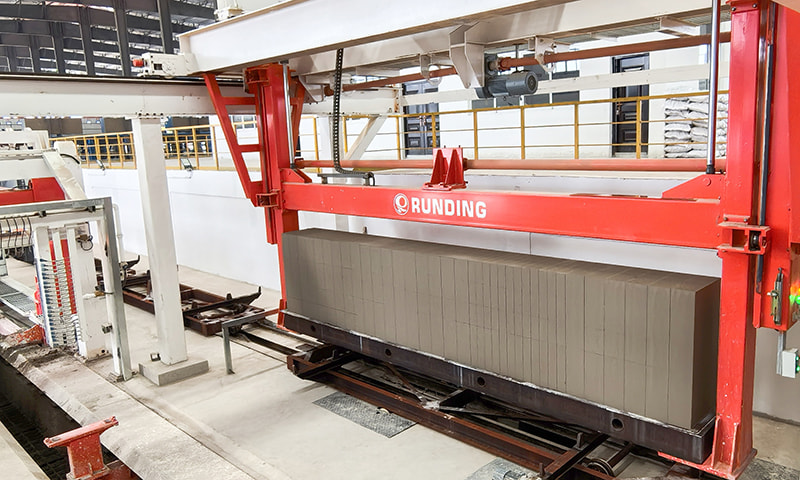
A high-quality AAC block production line employs a CNC-controlled cutting system with multiple wire frames. The cutting process is carried out in three orthogonal directions: horizontal, vertical, and cross-cutting. The wires are tensioned to exact specifications, and the cutting carriage moves along precision ground rails. After each cutting cycle, the system automatically cleans the wires and checks for wear. This ensures that every block, whether produced at the start or the end of a shift, has identical length, width, and height tolerances (typically within ±1 mm).
Furthermore, the cutting stage is often integrated with a reject mechanism. If a dimensional sensor detects an out-of-tolerance block, it is automatically diverted from the production stream. This prevents unstable products from reaching the autoclave and subsequent packaging. In a well-run AAC block production line factory, the reject rate for dimensional issues can be kept below 0.5%, a testament to the stability achieved through automation.
Autoclaving: The Key to Crystalline Stability
The critical step for long-term material performance stability is autoclaving. In the autoclave, the AAC blocks are subjected to saturated steam at pressures of 8–12 bar and temperatures of 180–200°C for several hours. Under these conditions, the silica (from sand or fly ash) reacts with lime to form tobermorite crystals, which give AAC its high strength and durability. However, the crystal phase formed depends heavily on the temperature–pressure–time profile. Incomplete or uneven curing can produce metastable phases like C-S-H gel or xonotlite, which have different mechanical properties and long-term dimensional stability.
An advanced AAC block production line manages the autoclaving cycle with programmable ramp rates, hold times, and cooling rates. The autoclaves themselves are equipped with multiple temperature sensors and pressure transmitters. A centralized control system ensures that every autoclave follows the identical cycle, eliminating the batch-to-batch variations common in manual valve operation.
Moreover, modern production lines often use a group autoclave arrangement where steam is cascaded from one autoclave to another during the pressure release phase. This not only saves energy but also ensures that the cooling rate is controlled—rapid cooling can induce microcracks due to thermal shock. By standardizing the entire curing process, an AAC block production line guarantees that the tobermorite crystals are fully developed and uniformly distributed throughout each block.
The following table highlights the key autoclave parameters and their influence on stability:
| Autoclave Parameter | Stable Range | Consequence of Deviation |
|---|---|---|
| Heating rate | 1–1.5°C/min | Slow: incomplete crystal growth; Fast: thermal cracking |
| Holding pressure | 10–12 bar | Low pressure: low strength; High pressure: over-crystallization |
| Holding time | 6–10 hours | Short: under-cured core; Long: energy waste, no added benefit |
| Cooling rate | ≤1°C/min | Rapid cooling: residual stresses, warping |
By strictly adhering to such parameters, an AAC block production line factory produces blocks that exhibit consistent compressive strength (typically 3–7 MPa for structural grades) and minimal drying shrinkage (<0.5 mm/m), a key indicator of long-term stability.
In-Process Quality Monitoring and Feedback
Stability is not a one-time achievement; it requires continuous vigilance. An AAC block production line incorporates inline testing stations that provide real-time feedback to the control system. For example, after the green cutting stage, a sample block may be sent to an automated density scanner. If the density exceeds the target range, the system can adjust the aluminum dosage or the mixing time for the next batch. Similarly, after autoclaving, a non-destructive resonance frequency test can estimate compressive strength without breaking the block.
This closed-loop control architecture is what differentiates a fully integrated AAC block production line from a collection of standalone machines. The data from every production cycle—raw material consumption, expansion height, cutting dimensions, autoclave temperatures, and final test results—is logged into a manufacturing execution system (MES). Over time, the MES can perform statistical process control (SPC) to identify drift in any parameter before it leads to out-of-spec products.
For instance, if the fineness of ground sand begins to increase due to ball mill wear, the SPC chart will show a trend. The system can alert operators to adjust the grinding media or the feed rate. This predictive maintenance capability further enhances stability by preventing gradual deterioration. In a manual production environment, such drift might go unnoticed for days, resulting in hundreds of unstable blocks.
Reducing Human-Induced Variability
One of the underappreciated advantages of an AAC block production line is the reduction of human error. Even the skilled operators are subject to fatigue, distraction, and inconsistency. The production line replaces manual decisions—how long to mix, when to pour, how to set the cutting wires—with machine logic that executes the same routine every time. This does not eliminate the role of human operators; rather, it elevates them from repetitive adjustments to strategic monitoring and troubleshooting.
Furthermore, an AAC block production line factory typically implements standardized operating procedures that are enforced by the control system. Operators cannot accidentally skip a step or alter a critical parameter. This level of discipline is essential for industries like construction, where building codes require certified material properties. By providing traceable production logs, the line also simplifies quality audits.
Long-Term Performance Benefits
When material performance stability is achieved through an AAC block production line, the benefits extend beyond the factory gate. Contractors and builders can rely on consistent block dimensions, which reduces mortar usage and speeds up wall construction. Engineers can confidently design with specified compressive strengths and densities, knowing that the delivered blocks will meet those values. Homeowners experience fewer cracks, better thermal comfort, and longer building life.
From a lifecycle perspective, stable AAC also contributes to sustainability. When blocks have uniform strength, structures can be designed with minimal safety margins, reducing material waste. Stable drying shrinkage means less cracking, which reduces maintenance and repair needs over the building’s lifetime. Thus, the investment in a high-quality production line pays dividends in both performance and environmental impact.
Conclusion
Material performance stability in AAC is not a matter of luck or simple recipe following. It is the result of meticulous control across every stage of production: raw material dosing, mixing, expansion, cutting, and autoclaving. An AAC block production line provides the technological framework to achieve this control through automation, sensor feedback, and standardized cycles. By eliminating the sources of variability—human error, inconsistent ingredient proportions, temperature fluctuations, and uneven curing—the production line ensures that each block leaving the factory is virtually identical to the last. This reliability is what makes AAC a trusted material in modern construction. For any manufacturer seeking to produce high-quality AAC, adopting a fully integrated AAC block production line is not an option but a necessity.
FAQ
Q1: What is the critical factor in an AAC block production line for ensuring material stability?
A1: While all stages matter, the autoclaving process is often the critical because it determines the formation of tobermorite crystals, which directly control long-term strength and shrinkage stability. Consistent temperature and pressure profiles are essential.
Q2: Can an AAC block production line factory handle different raw material variations (e.g., fly ash vs. sand)?
A2: Yes, modern production lines are designed with flexible recipes and adjustable grinding parameters. The control system can switch between formulations by changing dosing proportions and autoclaving cycles, maintaining stability even when input materials vary.
Q3: How does automation reduce dimensional errors in AAC blocks?
A3: Automation uses CNC-controlled cutting frames with precision wire tensioning and rail guidance. Sensors verify block dimensions after cutting and automatically reject any out-of-tolerance units, ensuring consistent sizes within ±1 mm.
Q4: What maintenance practices are recommended to preserve stability over time?
A4: Regular calibration of load cells, temperature sensors, and pressure transmitters is essential. Also, periodic checks of cutting wire wear and autoclave door seals prevent gradual drift. Many lines include predictive maintenance alerts based on SPC data.
Q5: Does a higher level of automation always better stability?
A5: Not necessarily. The key is not the degree of automation but the presence of closed-loop feedback. A line that measures critical parameters and adjusts in real time—even with moderate automation—will outperform a highly automated line without sensors and control logic. However, integrated systems with full feedback generally yield the stability.