

 English
 中文简体
中文简体 русский
Introduction
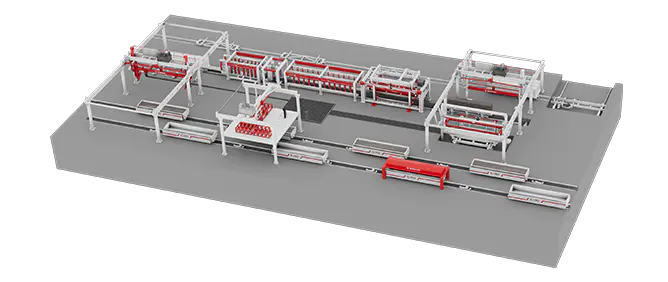
The Autoclaved Aerated Concrete (AAC) block production line is a revolutionary system for producing lightweight concrete blocks that offer exceptional thermal insulation, soundproofing, and fire-resistant properties. One of the important stages in the AAC production process is the foam concrete molding. This phase is crucial for ensuring the final product’s strength, durability, and overall quality.
Understanding AAC and Foam Concrete
AAC is a type of precast concrete that contains air pockets within its structure, making it much lighter than traditional concrete. This lightweight nature is achieved through the incorporation of foam in the production process, which forms the air pockets. Foam concrete, a variant of AAC, is created by mixing a foaming agent with a base of cement, lime, and sand to create a slurry that can be molded into various shapes. The foam concrete molding process is essential in producing the uniform blocks required for the construction industry.
The Initial Preparation of Foam Concrete
Before the molding process can begin, the foam concrete needs to be prepared by mixing the ingredients in the correct proportions. The foam is typically generated by using a foaming agent, which is mixed with water to create stable bubbles. These bubbles are then blended into a slurry of cement, lime, and sand. The quality of the foam and its stability is critical in ensuring that the concrete has the desired consistency and strength.
Materials Used
- Cement
- Lime
- Sand
- Water
- Foam (generated by foaming agent)
Preparation Process
Mix the cement, lime, and sand in the correct proportions.
Create the foam using a foaming agent and water.
Combine the foam with the slurry to create foam concrete.
Molding the Foam Concrete
Once the foam concrete is prepared, it is poured into molds. The molding stage is crucial for determining the shape and size of the final product. The molds used in the AAC block production line are typically made of high-strength steel or other durable materials. They are designed to hold the foam concrete in place as it sets and cures. During this stage, the foam concrete is poured into molds that have been precisely calibrated to produce blocks of specific sizes.
Key Factors Affecting the Molding Process
- Mold design: Ensuring that the molds are the correct size and shape is essential for producing uniform AAC blocks.
- Pouring technique: The method of pouring the foam concrete into the molds can influence the uniformity and density of the blocks.
- Foam consistency: The foam’s stability during the pouring process ensures the concrete’s desired strength.
Mold Types and Equipment
- Mold material: Steel, aluminum, or other durable metals.
- Molding equipment: Automatic mold filling machines, vibration tables, and conveyor systems.
Curing the Foam Concrete in Molds
After the foam concrete is poured into the molds, the next step is curing. Curing is a critical process that allows the foam concrete to gain strength and durability. In AAC production lines, curing is typically done under controlled conditions, where steam is applied to accelerate the curing process. The temperature and pressure within the curing chamber are carefully regulated to ensure hydration and hardening of the foam concrete.
Curing Process
Transfer the molds to an autoclave or curing chamber.
Apply high-pressure steam to the molds.
Maintain a specific temperature and pressure for a set period.
Curing Parameters
- Temperature: 180°C to 200°C.
- Pressure: 1.2 to 1.5 MPa.
- Curing time: 8 to 12 hours, depending on the desired block properties.
Demolding and Quality Control
Once the foam concrete has fully cured, it is ready for demolding. The blocks are carefully removed from the molds and inspected for quality. This is an important step to ensure that the blocks meet the required standards for strength, durability, and uniformity. In many AAC production lines, automated systems are used to demold the blocks and inspect them for any defects.
Quality Control Measures
- Visual inspection: Check for any cracks, air pockets, or inconsistencies in the blocks.
- Strength testing: Perform tests to ensure that the blocks meet the required load-bearing standards.
- Dimensional accuracy: Ensure that the blocks are within the correct size specifications.
Final Product Handling and Packaging
After passing the quality control checks, the foam concrete blocks are ready for further handling and packaging. Depending on the requirements, the blocks may be stacked, wrapped, and shipped to construction sites or storage facilities. The packaging process ensures that the blocks are securely transported without damage.
Handling and Packaging Process
Stack the blocks for transportation.
Wrap the blocks in protective packaging.
Load the blocks onto trucks or storage racks for delivery.
Factors Affecting the Foam Concrete Molding Process
Several factors can influence the efficiency and quality of the foam concrete molding process in an AAC production line. These include the quality of the raw materials, the design of the molds, and the precision of the curing process. Ensuring that these factors are optimized is crucial for achieving the possible results.
Key Challenges and Solutions
The foam concrete molding process is not without its challenges. Common issues include inconsistent foam consistency, mold misalignment, and curing temperature fluctuations. These problems can defective blocks that may not meet quality standards. Solutions to these challenges include using high-quality foaming agents, implementing automated control systems, and conducting regular maintenance on molding equipment.
FAQ
Q1: What is the role of foam in AAC block production?
A1: Foam is used to create air pockets within the concrete, making the blocks lightweight and enhancing their insulation properties.
Q2: How long does the curing process take for foam concrete?
A2: The curing process typically takes 8 to 12 hours, depending on the temperature, pressure, and desired block properties.
Q3: What materials are required for producing foam concrete?
A3: The materials required include cement, lime, sand, water, and a foaming agent to generate the foam.
Q4: What equipment is used in the foam concrete molding process?
A4: The process uses molds, automatic filling machines, vibration tables, and conveyor systems to pour and shape the foam concrete.
Q5: What are the common quality control tests performed on AAC blocks?
A5: Common tests include visual inspections, strength testing, and dimensional accuracy checks to ensure the blocks meet quality standards.